Written by the Hunter Leveling lore desk. Mechanics checked against both series’ published rules, not against a crossover chart that does not exist.
Both Sung Jinwoo and Allen start at the absolute bottom of their worlds, but their progression systems run on opposite philosophies: one is an inescapable leash, the other is an absurd voluntary bet. The Solo Leveling System vs Hell Mode split is that simple. Jinwoo never ticked a difficulty box. The Architect’s program chose him in the Double Dungeon — the same temple the Beyond the System movie returns to — then made rest expensive. Yamada Kenichi, a 35-year-old salaryman hunting for a game hard enough to waste thousands of hours on, selected Hell Mode off an untitled invitation and woke up as Allen, a serf with no money and no status. One man is collared. The other signed a contract.
The progression architecture
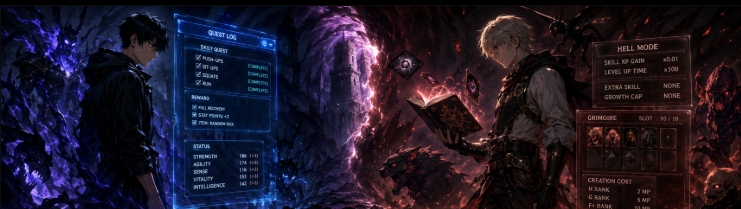
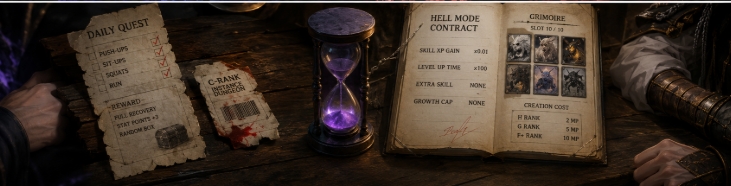
Jinwoo’s loop is instant and lethal. Daily quests are push-ups, sit-ups, squats, and a run. Clear the list and the log pays a full heal, three stat points, and a loot box. Instance dungeons pay more because they risk more. The dimensional shop sits behind the same HUD. Stat points drop into Strength, Agility, Sense, Vitality, or Intelligence the same day. Fail the timer and the world does not wait for next week. Other hunters freeze at awakening. He keeps receiving numbers until the meter in Seoul goes dark in webtoon Ch. 62 and the office is forced to stamp S. After that he leaves the census altogether and scales into the Monarch power tiers the Association has no letter for.
Allen’s loop is the inverse: long compounding with almost no UI safety net. Hell Mode’s contract is explicit. Gaining and leveling skills takes a hundred times longer than Normal Mode. There is no extra-skill roll at creation, only the class kit. There is also no development cap if you survive the despair long enough to learn a Principle of the World. Allen’s secret childhood grind carries him through his early years in Kurena Village, killing garden pests, hunting Albaherons, and quietly passing the village knights, before the story shifts that same hundredfold tax into Academy City, dungeon raids, and a party that has to invent its own strategies.
The Summoner kit is strict inventory management, not effortless necromancy. Cards live in a Grimoire that starts with 10 slots; Expansion adds 10 more each time Summoning levels up. Creation spends MP to print a card — 2 MP for rank H, then 5 MP for rank G, then 10 MP from F upward. Insects and Beasts are the only types he can create directly: insects for debuffs, beasts for front-line strikes. Higher-tier summons have to be synthesized. A scouting Bird costs extra mana on top of those two types, and late-game tiers such as Spirit, Dragon, and Angel demand the same arithmetic plus free Grimoire pages. Jinwoo’s army scales in the opposite direction. Shadow Extraction’s skill card lists no mana cost, fires on a command word, and allows three attempts per corpse, with failure chance scaling to the target’s stats and how long they have been dead. The real drain is combat: damaged soldiers pull from his mana pool to regenerate. Storage is free. Once a soul sits in his shadow, upkeep is zero, and capacity simply scales with his stats from roughly twenty soldiers early on to thousands parked in that domain.
Penalties and failure states
Miss Jinwoo’s daily list and the Penalty Zone opens: four hours in a starless desert with poison-fanged giant sand centipedes, the pack scaling up if he tries to farm it. Special failures can stop his heart. While he faces that death sentence the same afternoon if he neglects the regimen, Allen’s failure state simply locks him into years of stagnant manual labor. One system threatens instant execution; the other threatens perpetual obscurity. Put Allen in a C-gate with garden-pest XP and the Hell Mode tax still applies. Put Jinwoo in Kurena Village and the dawn quest still fires whether the lord allows it or not.
Solo Leveling System vs Hell Mode, side by side
- Origin. Jinwoo: involuntary. Architect assigns Player in the Double Dungeon. Allen: voluntary. Hell Mode ticked on a difficulty screen.
- XP. Jinwoo gets quest-clear stats the same day, with instances paying more. Allen’s skill gain and level-up take 100× Normal Mode.
- Failure. Jinwoo: Penalty Zone, and a heart-stop on special fails. Allen: no stat that day, then years of serf labor.
- Class on paper. Jinwoo is a hidden Player; the Association reads E, then S when the meter dies. Allen is a hidden Summoner; appraisal reads no Talent.
- Army and storage. Jinwoo: Extraction lists no MP on the skill card, three tries per corpse; regen in battle drains MP; storage is free; cap starts around 20 and scales. Allen: Grimoire starts at 10 card slots, plus 10 per Expansion; Creation costs MP (2 for rank H); Insects and Beasts are direct; higher types are synthesized.
- Ceiling. Jinwoo’s cap is the story: Shadow Monarch, the Cup, the 27-year war. Hell Mode says uncapped. Normal Mode in that world is capped.
- Copyability. Jinwoo is a singleton; no other hunter gets the log. Allen is a hardcore setting inside a shared talent world.
Class dynamics and stealth scaling
Both men look talentless at the start, and that is the whole trick. Korea stamps Jinwoo E because the census only reads leaked mana, then panics when the crystal cannot score him. Giamut’s appraisal prints “no Talent” on Allen because Summoner sits outside that magic. False Rankers in Solo Leveling pinch their output on purpose. Allen is not pinching. The class is invisible. He still has to stay mobile in light armor so he can keep the ledger of summons in the air, which is why academy classmates treat the insect-farming as a personality defect rather than a build.
Jinwoo’s exclusivity is the sharper wall. Korea’s hunters cannot copy the log. Giamut’s talents can copy a class if they rolled it. Stretch Jinwoo’s engine until Monarchs die and you get the 27-year war KARMA is selling as a roguelite. Allen never hears of Antares. He is a hardcore gamer in a world that already had classes. Jinwoo is a glitch in a world that thought ranks were frozen.
System compatibility and power-scaling limits
Hamuo’s novel and the anime never printed a conversion that says Summoner level X equals S-rank, and D&C Media has never put Allen next to Thomas Andre on a chart. Early Allen maps to E-rank work with a hidden class, grinding toward a talent local knights would call A if they could see it. Early Jinwoo maps to the same E-rank work with a hidden Player flag, then leaves the census after Ch. 62. After that the systems stop talking to each other. One army is extracted souls with free storage and a mana bill only when they have to be rebuilt in a fight. The other is synthesized types with a mana invoice on every card and a hard page limit on the Grimoire. Mixing those ledgers is fan math, not a published rule.
While Jinwoo can die the same afternoon he skips a run, Allen can waste a childhood on a tax he chose. That is the whole contrast worth keeping.